V&P Scientific Enables Nanoscale Spotting for the Purdue “Make It” Platform

Pin Tools in High-Throughput Chemistry Enable Nanoscale Spotting for the Purdue “Make It” Platform

High-throughput screening has become the core for pharmaceutical lead candidate discovery in organic synthesis. The ability to transfer small, precise volumes of liquid consistently is essential. A paper in SLAS Technology (2021) by Morato et al. (SLAS Technology Paper) describes the Purdue Make It system that automates small-scale synthesis, reaction screening, and direct bioassays using desorption electrospray ionization mass spectrometry (DESI-MS). This workflow was achieved using a slotted 384-pin tool from V&P Scientific.

The Purdue Make It System

The DESI-MS system was automated using a Biomek i7 workstation and achieved high-throughput screening of up to 6,144 samples in a single run. Analysis of each sample required very little material for the initial Mass Spec and structural characterization. This reduces reagent consumption to enable more experiments per sample. Data is visualized through heatmaps based on the m/z values of the protonated forms relative to the background used to create the segmented heatmap. This system has been applied to reaction screenings of up to 188 unique reactions across 24 types. The key component that enables this system is the ability to transfer reaction mixtures or samples from master plates onto specialized DESI analysis plates at nanoscale volumes. Figure 1, below, summarizes the general workflow of the platform.
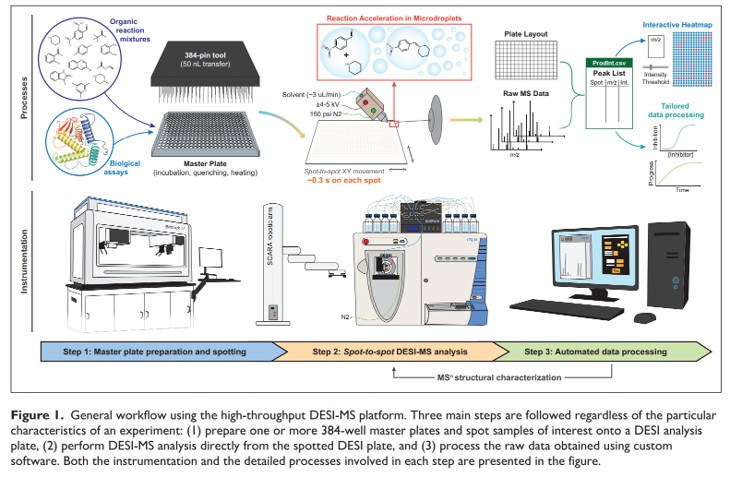
General workflow of the high-throughput DESI-MS platform using a 384-pin tool
Figure 1. General workflow of the high-throughput DESI-MS platform (Morato et al., 2021)

The Role of Pin Tools

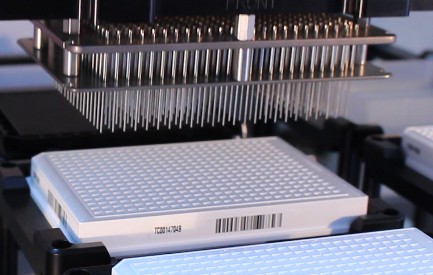
384-pin tool transferring into a 384-well plate
384-Pin Tool Transfer

The Purdue Make It System relies on the preparation of 384-well master plates. Then, 50nL samples are spotted onto DESI plates using a slotted 384-pin tool. These DESI plates were prepared in-house using customized soda-lime glass slides that have the traditional standard well plate footprint. A porous polytetrafluoroethylene (PTFE) membrane is attached to each slide using a light spray adhesive.

The 384-pin tool is integrated with the Biomek robot to spot the samples onto these DESI plates with ~50 µm positional accuracy. By using up to 16 programmed shifts available on the Biomek robot, the system can achieve up to 6,144 reaction spots per plate. These high-density spots have center-to-center distances of 1.125mm at the highest density. The plates are customizable and user-defined, allowing multiple master plates to be pinned onto one DESI plate, or leaving some positions unoccupied.

The arrays are routinely generated with 50nL transfers from the 384-pin tool. Typical operating densities are 1,536 spots per plate with up to four technical replicates per master plate well. The spotted slides are transferred for analysis with up to one sample per second throughput.

How Pin Tools Differentiate from Traditional Liquid Handling

Traditional liquid handlers, such as pipettes, can struggle to transfer very low volumes reliably. Where these traditional systems fail, pin tools excel, delivering robust, solvent-compatible transfers onto non-standard surfaces such as PTFE-coated slides.

  • Volume Control and Reliability: Slotted pins are designed to pick up and deposit consistent nanoliter amounts by capillary action and controlled contact.
  • Speed and Density: A full 384-pin tool transfers an entire plate’s worth of samples in one motion, and shifts can be used for high density spotting.
  • Compatibility: Works well with organic solvents and complex mixtures.
  • Automation: Adaptable onto robotic decks for hands-off, high-throughput screening.
  • Minimal Consumables: The pin tool eliminates tip waste compared with disposable pipette tips.

Practical Takeaways for Lab Usage

Pin tools are an effective way to achieve high-throughput transfer of small volumes reliably, and consistently. The ability to automate the process on robot decks turns nanoscale spotting into a seamless part of a continuous synthesis-and-analysis workflow.

When implementing pin tools in your own lab:

  • Calibrate the tool carefully for the specific conditions and volume transfer you want to achieve.
  • Take advantage of high-density spotting capabilities through shifts in spotting.
  • Validate a small test to confirm transfer volume, spot quality, and analytical performance before scaling-up.
  • Keep the pin tools clean during use to ensure long-lasting performance.

Pin tools provide a robust, low-consumable, and highly parallel solution for researchers that need to screen nanoliter scale chemical spaces in pursuit of lead candidates. In the Purdue Make It system, pin tools form the critical bridge between robotic plate preparation and ionization mass spectrometry, enabling rapid reaction screening in addition to direct bioassays with minimal sample consumption.

Reference

Morato, N. M., Le, M. T., Holden, D. T., & Cooks, R. G. (2021). Automated High-Throughput System Combining Small-Scale Synthesis with Bioassays and Reaction Screening. SLAS Technology, 26(6), 555–571. https://doi.org/10.1177/24726303211047839

Hydrophobic Coated vs Non-Coated Pin Transfers

Solid Pin Delivery Data For Aqueous Solutions In 96 Format With Uncoated And /Ah Hydrophobic Coated Pins
PinDescriptionnl TransferredCV%
0.229 mm diameter (FP9)Total PinUncoated7.412.4
Hydrophobic7.465.4
0.229 mm diameter (FP9)Hanging DropUncoatedN/AN/A
Hydrophobic2.093.8
0.457 mm diameter (FP1)Total PinUncoated33.483.2
Hydrophobic28.177.5
0.457 mm diameter (FP1)Hanging DropUncoated16.964.5
Hydrophobic8.510.8
0.787 mm diameter (FP3)Total PinUncoated87.323.9
Hydrophobic77.43.9
0.787 mm diameter (FP3)Hanging DropUncoated48.771.2
Hydrophobic43.059.4
1.19 mm diameter  (VP 409 & VP 386)Total PinUncoated247.222.8
Hydrophobic192.672.6
1.19 mm diameter (VP 409 & VP 386)Hanging DropUncoated76.351.6
Hydrophobic108.42.8
1.58 mm diameter (VP 408 & VP 384)Total PinUncoated273.54.6
Hydrophobic259.253.1
1.58 mm diameter (VP 408 & VP 384)Hanging DropUncoated201.935
Hydrophobic170.047.5

Transfer Of Horseradish Peroxidase In Tris Buffered Saline With Pin Tools

Conclusion

Coating pins will reduce the total amount of liquid transferred and also reduce the amount of non-specific binding to the stainless-steel pins. If the substance you are transferring has high non-specific binding this will be an important factor in selecting your pins.

Slot Pin Delivery Data For Aqueous Solutions In 96 Format With Uncoated And /Ah Hydrophobic Coated Pin
PinDescriptionnl TransferredCV%
0.229 mm diameter (FP9)Total PinUncoated7.412.4
Hydrophobic7.465.4
0.229 mm diameter (FP9)Hanging DropUncoatedN/AN/A
Hydrophobic2.093.8
0.457 mm diameter (FP1)Total PinUncoated33.483.2
Hydrophobic28.177.5
0.457 mm diameter (FP1)Hanging DropUncoated16.964.5
Hydrophobic8.510.8
0.787 mm diameter (FP3)Total PinUncoated87.323.9
Hydrophobic77.43.9
0.787 mm diameter (FP3)Hanging DropUncoated48.771.2
Hydrophobic43.059.4
1.19 mm diameter  (VP 409 & VP 386)Total PinUncoated247.222.8
Hydrophobic192.672.6
1.19 mm diameter (VP 409 & VP 386)Hanging DropUncoated76.351.6
Hydrophobic108.42.8
1.58 mm diameter (VP 408 & VP 384)Total PinUncoated273.54.6
Hydrophobic259.253.1
1.58 mm diameter (VP 408 & VP 384)Hanging DropUncoated201.935
Hydrophobic170.047.5

Transfer Of Horseradish Peroxidase In Tris Buffered Saline With Pin Tools

Conclusion

Although the slots in the pin are a precise volume, the liquid that is transferred is usually more. The reason for this is due to the surface tension of the liquid causing the liquid in the slot to “bow out” thus increasing the volume of the liquid in the slot. If is important for you to transfer exactly a certain volume we can make custom slots to match the surface tension characteristics of your liquid

Liquid Surface Tension

Effect Of DNA Or BSA Concentration On Slot Pin Transfers Of Uncoated And Hydrophobic Coated Pins (FP3CS500)
Solvent/SampleConcentrationCV%nl FITC TransferredCV%nl FITC Transferred
UncoatedUncoatedHydrophobic CoatedHydrophobic Coated
DMSO (-)08.1353.427.5298.72
DMSO + DNA (mg/ml)0.56.6497.216.6435.86
0.259432.494.1391.93
0.1258.9363.640.9344.75
0.06252.3381.862331.68
0.03131.5378.034.4331.71
0.01561.2357.521.4329.03
Tris (-)04.9577.317.2493.53
Tris + DNA (mg/ml)0.54.5540.531.1477.5
0.254.6518.216.1456.75
0.12515.8583.254.1438.82
0.06254.2551.173.1433.69
0.03134.4536.662.3458.37
0.01562.9528.531.2441.1
Tris + BSA (%)45.4462.1311409.27
14452.862.7426.58
0.2511.7456.451.3408.72
0.06251.1445.226.5393.07
0.01563.7462.853.9430.2
0.00391.5493.542.2437.29
0.0012.9504.250.7475.96
Conclusions

1. Increasing the concentration of DNA (sheared salmon sperm) to .25 mg/ml significantly increases the volume of DMSO liquid transferred for both coated and uncoated FP3S500 Slot Pins.
2. Increasing the concentration of DNA does not significantly increase the volume of Tris buffer (aqueous) transferred by both coated and uncoated FP3S500 Slot Pins.
3. Increasing the concentration of BSA (Bovine Serum Albumin) significantly decreases the volume of Tris buffer transferred by both coated and uncoated FP3S500 Slot Pins.
4. Hydrophobic coated FP3S500 Slot Pins transferred less DMSO – DNA and less Tris DNA and less Tris BSA than the uncoated FP3S500 Slot Pins.
5. Both coated and uncoated FP3S500 pins transfer significantly more aqueous solution than DMSO.

Effect Of DNA Or BSA Concentration On Slot Pin Transfers Of Uncoated And Hydrophobic Coated Pins (FP1CS50)
Solvent/SampleConcentrationCV%nl FITC TransferredCV%nl FITC Transferred
UncoatedUncoatedHydrophobic CoatedHydrophobic Coated
DMSO (-)04.249.382.149.31
DMSO + DNA (mg/ml)0.54.951.242.656.79
0.251.750.21.249.53
0.1251.551.272.349.77
0.06252.249.344.148.19
0.03131.249.030.250.23
0.01562.445.91.446.64
Tris (-)02.689.512.991.34
Tris + DNA (mg/ml)0.5777.110.684.62
0.253.982.221.684.89
0.1253.985.42185.08
0.06251.585.362.885.03
0.0313284.52388.19
0.01562.682.922.883.2
Conclusions

1. In contrast to the FP3S500 data, increasing the concentration of DNA to .25 mg/ml does not significantly increase the volume of DMSO liquid transferred for both coated and uncoated FP1S50 Slot Pins.
2. Increasing the concentration of DNA does not significantly increase the volume of Tris buffer (aqueous) transferred by both coated and uncoated FP1S50 Slot Pins.
3. In contrast to the FP3S500 data, FP1S50 coated pins transferred about the same volume of DNA at all concentrations as did uncoated pins.
4. Both coated and uncoated FP1S50 pins transfer significantly more aqueous solution than DMSO.
5. The differences between the FP3S500 and the FP1S50 pin may be due to the different pin diameter’s effect on contact angle and therefore on the “wetting” of the pin. See the diagram on the link to / ah energy system.

PinDescriptionnl TransferredCV%
0.229 mm diameter (FP9)Total PinUncoated7.412.4
Hydrophobic7.465.4
0.229 mm diameter (FP9)Hanging DropUncoatedN/AN/A
Hydrophobic2.093.8
0.457 mm diameter (FP1)Total PinUncoated33.483.2
Hydrophobic28.177.5
0.457 mm diameter (FP1)Hanging DropUncoated16.964.5
Hydrophobic8.510.8
0.787 mm diameter (FP3)Total PinUncoated87.323.9
Hydrophobic77.43.9
0.787 mm diameter (FP3)Hanging DropUncoated48.771.2
Hydrophobic43.059.4
1.19 mm diameter  (VP 409 & VP 386)Total PinUncoated247.222.8
Hydrophobic192.672.6
1.19 mm diameter (VP 409 & VP 386)Hanging DropUncoated76.351.6
Hydrophobic108.42.8
1.58 mm diameter (VP 408 & VP 384)Total PinUncoated273.54.6
Hydrophobic259.253.1
1.58 mm diameter (VP 408 & VP 384)Hanging DropUncoated201.935
Hydrophobic170.047.5

Aqueous Transfer with Solid Pins

Hydrophobic coating pins will reduce the total amount of aqueous HRP liquid transferred and also reduce the amount of non-specific binding to the stainless-steel pins. If the substance you are transferring has high non-specific binding this will be an important factor in selecting your pins.


Pin diameter also has an effect on the degree of reduction of liquid transfer with hydrophobic coating as the smaller the diameter the less the reduction of transfer. This is most likely due to the curvature of the pin affecting the wetting contact angle

PinDescriptionnl TransferredCV%
0.457 mm diameter (FP1)6 nl SlotTotal Pin*Uncoated25.610.8
HydrophobicN/AN/A
10 nl SlotTotal Pin*Uncoated23.366.1
Hydrophobic25.856.9
50 nl SlotTotal Pin*Uncoated67.832.5
HydrophobicN/AN/A
0.787 mm diameter (FP3)  100 nl SlotTotal Pin*Uncoated180.327.2
Hydrophobic205.845.5
200 nl SlotTotal Pin*Uncoated277.824.9
Hydrophobic287.33.8
500 nl SlotTotal Pin*Uncoated581.165.2
Hydrophobic555.693

DMSO Transfer with Slot Pins

Hydrophobic coating pins will slightly increase the total amount of DMSO FITC liquid transferred.

PinDescriptionnl TransferredCV%
0.787 mm diameter (FP3)    100 nl Slot Total Pin, Including SlotUncoated195.691.6
Hydrophobic170.22.9
0.787 mm diameter (FP3)  100 nl Slot, Slot OnlyUncoated149.674.9
Hydrophobic129.617.6
0.787 mm diameter (FP3)200 nl Slot Total Pin, Including SlotUncoated269.771.9
Hydrophobic228.6217.1
0.787 mm diameter (FP3)200 nl Slot, Slot OnlyUncoated237.528.9
Hydrophobic186.95.9

Aqueous Transfer with Slot Pins

Although the slots in the pin are a precise volume, the liquid that is transferred is usually more because of the volume carried on the sides of the pins. 

As seen with other aqueous data the amount transferred on hydrophobic coated Slot pins is less than on uncoated Solid or Slot pins. Thus Hydrophobic coating has the most effect on aqueous transfers.

Withdrawl Speeds Impact on Volume Transfer

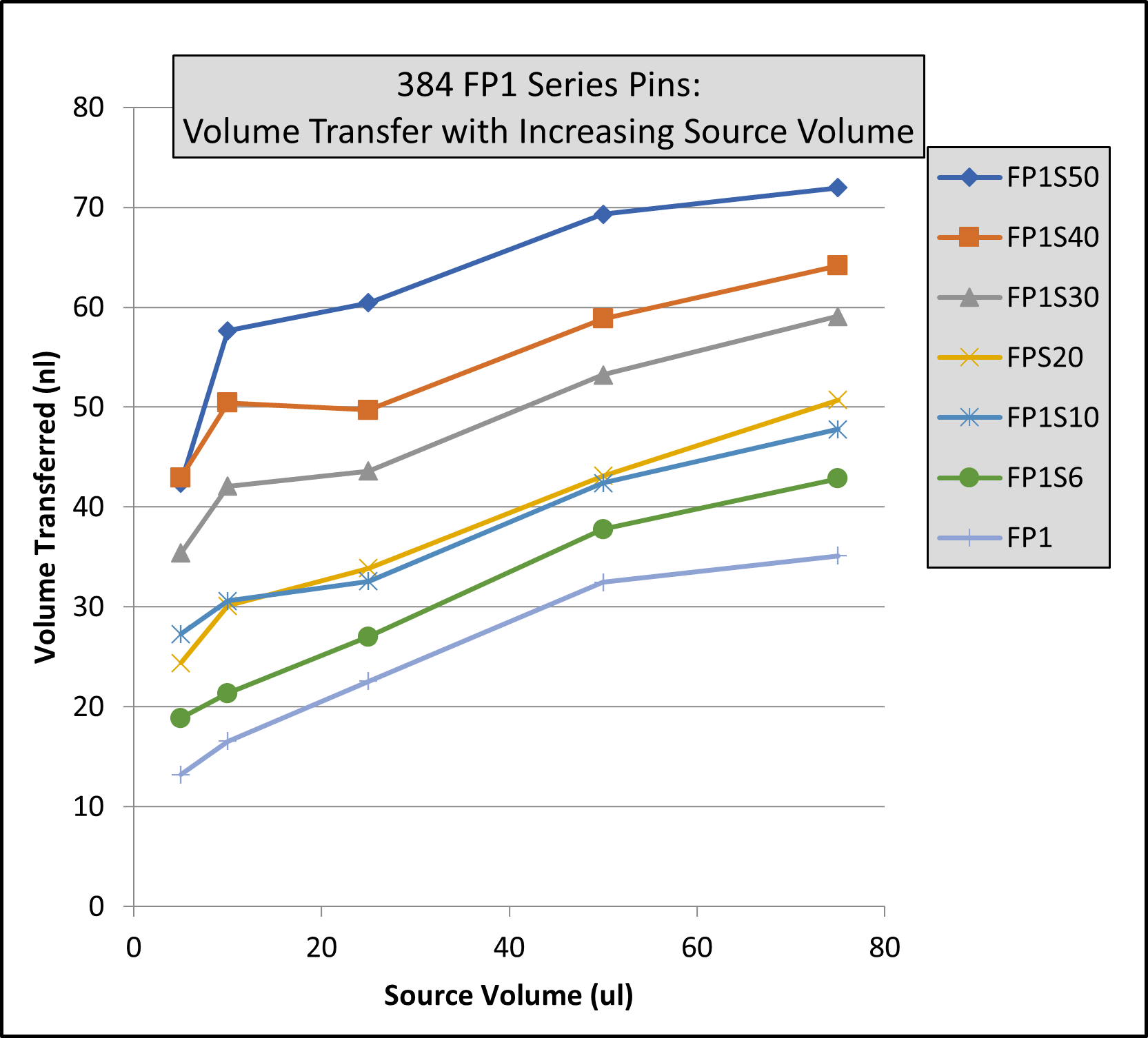
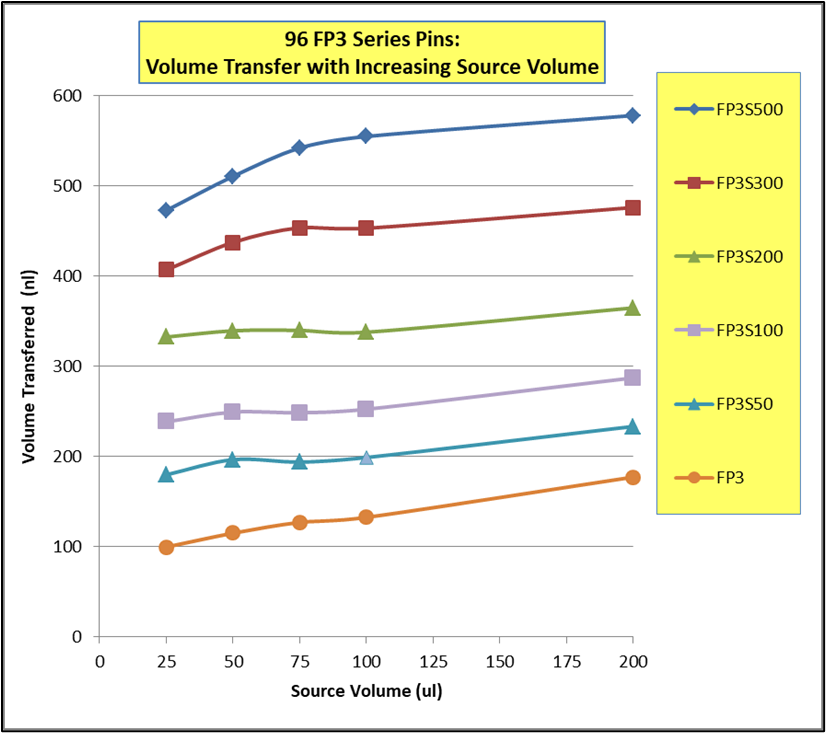
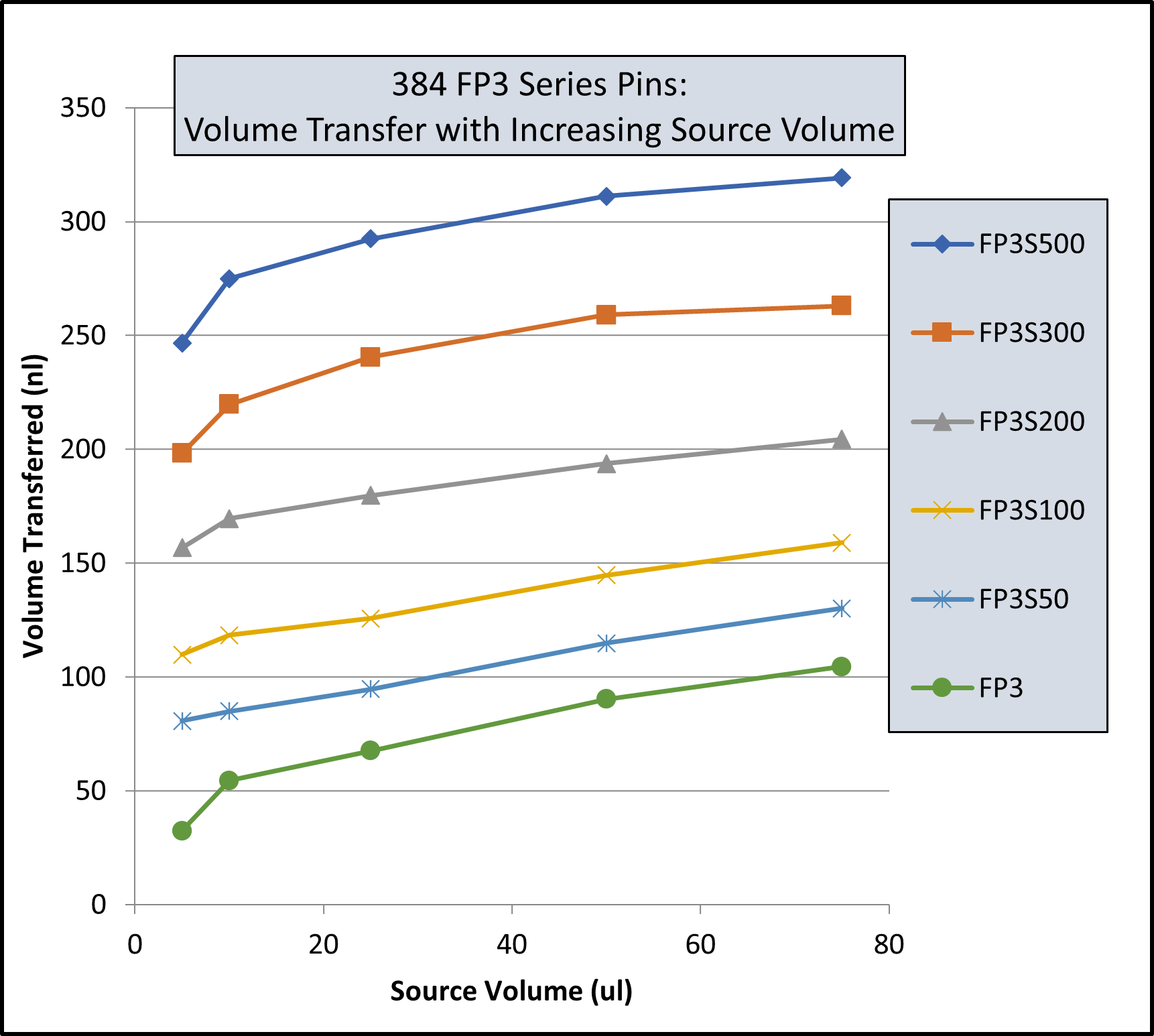
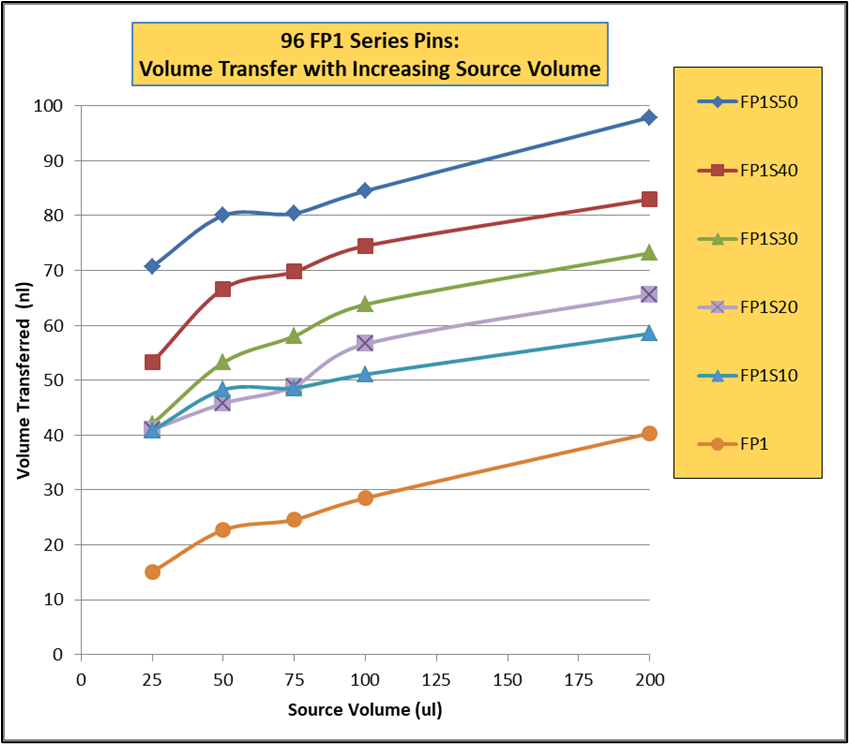
Solid Pins More affected by Source Plate Volume

Volume Transferred For FP1 Pins (Uncoated) In 96 And 384 Formats
Volume Transferred For FP3 Pins (Uncoated) In 96 And 384 Formats

Note: Same volume (200ul for 96 Format and 74 ul for 384 Format) in recipient plates and same pin withdrawal speed for all pins. Changes to pin withdrawal speed or volume in the source plate can result in different volumes being transferred.

Transfer volumes should always be confirmed by customers for their assay conditions and automated system.

Aqueous Solutions Pin Transfer Volumes Ranges

Aqueous Solutions on Uncoated Pins in 96 Format Microplates(1)
Pin TypePin Diameter(mm)Shape96 Format Low Range(nL)²96 Format High Range(nL)²
FP90.229Solid1339
FP80.356Solid1537
FP10.457Solid2261
FP1S60.4576nL Slot3467
FP1S100.45710nL Slot3974
FP1S500.45750nL Slot90124
FP30.787Solid93213
FP3S1000.787100nL Slot213334
FP3S2000.787200nL Slot311449
FP3S5000.787500nL Slot515671
FP40.914Solid126289
Footnotes: (1) Delivery volume range is determined by speed of withdrawal from source liquid: Z-Speed Range = 1.5-30 mm/sec, slow speed = low volume delivery range, fast speed = high volume delivery range (2) 200ul source plate volume per well
Aqueous Solutions on Hydrophobic Pins in 96 Format Microplates(1)
Pin TypePin Diameter(mm)Shape96 Format Low Range(nL)²96 Format High Range(nL)²
FP90.229Solid1338
FP80.356Solid
FP10.457Solid2360
FP1S60.4576nL Slot3367
FP1S100.45710nL Slot4075
FP1S500.45750nL Slot86119
FP30.787Solid76209
FP3S1000.787100nL Slot188324
FP3S2000.787200nL Slot288436
FP3S5000.787500nL Slot473649
FP40.914Solid
Footnotes: (1) Delivery volume range is determined by speed of withdrawal from source liquid: Z-Speed Range = 1.5-30 mm/sec, slow speed = low volume delivery range, fast speed = high volume delivery range (2) 200ul source plate volume per well
Aqueous Solution on E-Clip, Uncoated Pins(1)
Pin TypePin Diameter(mm)ShapeLow Range(nL)²High Range(nL)²
FP1.58Solid Pointed175594
FPS.51.58500nL Slot524962
FPS1.581000nL Slot10561476
FPS21.582000nL Slot17392174
FPS51.585000nL Slot51504953
FP61.58Solid Flat465960
FP6S.51.58500nL Slot9341445
FP6S1.581000nL Slot13961930
FP6S21.582000nL Slot20722637
FP6S51.585000nL Slot48204693
Footnotes:(1) Delivery volume range is determined by speed of withdrawal from source liquid: Z-Speed Range = 1.5-30 mm/sec, slow speed = low volume delivery range, fast speed = high volume delivery range (2) 200ul source plate volume per well for 96 Format and 75ul source plate volume per well for 384 Format

DMSO Pin Transfer Volume Range Charts

Uncoated Pins in 96 and 384 Format Microplates(1)
Pin TypePin Diameter(mm)Shape96 Format Low Range(nL)²96 Format High Range(nL)²384 Format Low Range(nL)³384 Format High Range(nL)³
FP90.229Solid41038
FP80.35Solid1326618
FP10.457Solid18431131
FP1S60.4576nL Slot24491534
FP1S100.45710nL Slot30542140
FP1S200.45720nL Slot37612746
FP1S300.45730nL Slot46683554
FP1S400.45740nL Slot57784563
FP1S500.45750nL Slot70905675
FP30.787Solid671392979
FP40.91Solid941973498
FP3S1000.787100nL Slot175241114163
FP3S2000.787200nL Slot280332203250
FP3S5000.787500nL Slot535559427464
FP4S10000.911000nL Slot9401011704800
FP4S20000.912000nL Slot1518160812771362
Footnotes: (1) Delivery volume range is determined by speed of withdrawal from source liquid: Z-Speed Range = 1.5-30 mm/sec, slow speed = low volume delivery range, fast speed = high volume delivery range (2) 200ul source plate volume per well (3) 75ul source plate volume per well
Hydrophobic-coated Pins in 96 and 384 Format Microplates(1)
Pin TypePin Diameter (mm)Shape96 Format Low Range(nL)²96 Format High Range(nL)²384 Format Low Range(nL)³384 Format High Range(nL)³
FP9H0.229Solid41038
FP8H0.35Solid924617
FP1H0.457Solid1539927
FP1S6H0.4576nL Slot23491432
FP1S10H0.45710nL Slot29532038
FP1S20H0.45720nL Slot35592643
FP1S30H0.45730nL Slot47693553
FP1S40H0.45740nL Slot54754158
FP1S50H0.45750nL Slot69905773
FP3H0.787Solid671342776
FP4H0.91Solid9518932102
FP3S100H0.787100nL Slot170227108164
FP3S200H0.787200nL Slot266320190239
FP3S500H0.787500nL Slot520542416456
FP4S1000H0.911000nL Slot9321000741805
FP4S2000H0.912000nL Slot1571163813511423
Footnotes: (1) Delivery volume range is determined by speed of withdrawal from source liquid: Z-Speed Range = 1.5-30 mm/sec, slow speed = low volume delivery range, fast speed = high volume delivery range (2) 200ul source plate volume per well (3) 75ul source plate volume per well
E-Clip, Uncoated Pins, for 96 and 384 Format Microplates(1)
Pin TypeDiameter (mm)Shape96 Format Low Range(nL)²96 Format High Range(nL)²384 Format Low Range(nL)³384 Format High Range(nL)³
FP1.58Solid Pointed147411168395
FPS.51.58500nL Slot442704631843
FPS1.581000nL Slot893113013431498
FPS21.582000nL Slot1911203826072767
FPS51.585000nL Slot3908429651805253
FP61.58Solid Flat323674154398
FP6S.51.58500nL Slot73410428551053
FP6S1.581000nL Slot1210150016381717
FP6S21.582000nL Slot2299238427873068
FP6S51.585000nL Slot4329465652375245
Footnotes:(1) Delivery volume range is determined by speed of withdrawal from source liquid: Z-Speed Range = 1.5-30 mm/sec, slow speed = low volume delivery range, fast speed = high volume delivery range (2) 200ul source plate volume per well (3) 75ul source plate volume per well