Pin Tools in High-Throughput Chemistry Enable Nanoscale Spotting for the Purdue “Make It” Platform
High-throughput screening has become the core for pharmaceutical lead candidate discovery in organic synthesis. The ability to transfer small, precise volumes of liquid consistently is essential. A paper in SLAS Technology (2021) by Morato et al. (SLAS Technology Paper) describes the Purdue Make It system that automates small-scale synthesis, reaction screening, and direct bioassays using desorption electrospray ionization mass spectrometry (DESI-MS). This workflow was achieved using a slotted 384-pin tool from V&P Scientific.
The Purdue Make It System
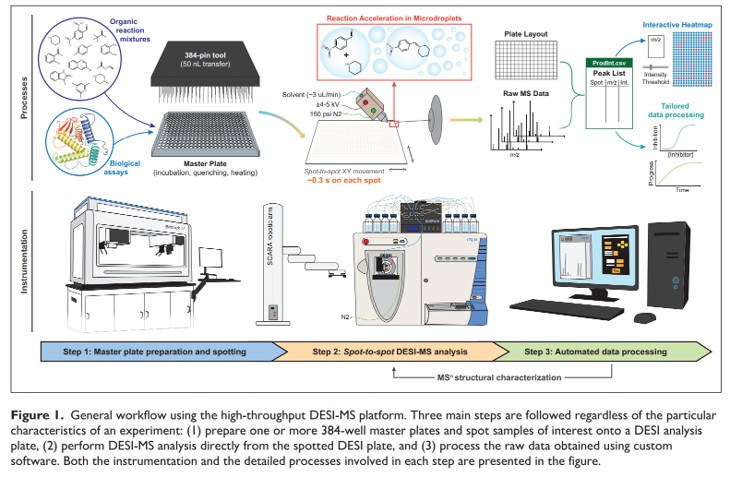
The DESI-MS system was automated using a Biomek i7 workstation and achieved high-throughput screening of up to 6,144 samples in a single run. Analysis of each sample required very little material for the initial Mass Spec and structural characterization. This reduces reagent consumption to enable more experiments per sample. Data is visualized through heatmaps based on the m/z values of the protonated forms relative to the background used to create the segmented heatmap. This system has been applied to reaction screenings of up to 188 unique reactions across 24 types. The key component that enables this system is the ability to transfer reaction mixtures or samples from master plates onto specialized DESI analysis plates at nanoscale volumes. Figure 1, below, summarizes the general workflow of the platform.
The Role of Pin Tools
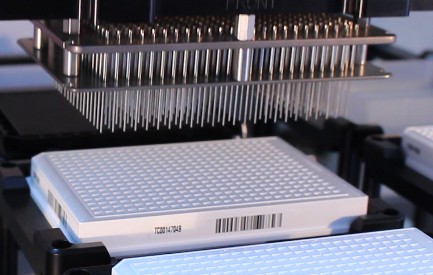
The Purdue Make It System relies on the preparation of 384-well master plates. Then, 50nL samples are spotted onto DESI plates using a slotted 384-pin tool. These DESI plates were prepared in-house using customized soda-lime glass slides that have the traditional standard well plate footprint. A porous polytetrafluoroethylene (PTFE) membrane is attached to each slide using a light spray adhesive.
The 384-pin tool is integrated with the Biomek robot to spot the samples onto these DESI plates with ~50 µm positional accuracy. By using up to 16 programmed shifts available on the Biomek robot, the system can achieve up to 6,144 reaction spots per plate. These high-density spots have center-to-center distances of 1.125mm at the highest density. The plates are customizable and user-defined, allowing multiple master plates to be pinned onto one DESI plate, or leaving some positions unoccupied.
The arrays are routinely generated with 50nL transfers from the 384-pin tool. Typical operating densities are 1,536 spots per plate with up to four technical replicates per master plate well. The spotted slides are transferred for analysis with up to one sample per second throughput.
How Pin Tools Differentiate from Traditional Liquid Handling
Traditional liquid handlers, such as pipettes, can struggle to transfer very low volumes reliably. Where these traditional systems fail, pin tools excel, delivering robust, solvent-compatible transfers onto non-standard surfaces such as PTFE-coated slides.
- Volume Control and Reliability: Slotted pins are designed to pick up and deposit consistent nanoliter amounts by capillary action and controlled contact.
- Speed and Density: A full 384-pin tool transfers an entire plate’s worth of samples in one motion, and shifts can be used for high density spotting.
- Compatibility: Works well with organic solvents and complex mixtures.
- Automation: Adaptable onto robotic decks for hands-off, high-throughput screening.
- Minimal Consumables: The pin tool eliminates tip waste compared with disposable pipette tips.
Practical Takeaways for Lab Usage
Pin tools are an effective way to achieve high-throughput transfer of small volumes reliably, and consistently. The ability to automate the process on robot decks turns nanoscale spotting into a seamless part of a continuous synthesis-and-analysis workflow.
When implementing pin tools in your own lab:
- Calibrate the tool carefully for the specific conditions and volume transfer you want to achieve.
- Take advantage of high-density spotting capabilities through shifts in spotting.
- Validate a small test to confirm transfer volume, spot quality, and analytical performance before scaling-up.
- Keep the pin tools clean during use to ensure long-lasting performance.
Pin tools provide a robust, low-consumable, and highly parallel solution for researchers that need to screen nanoliter scale chemical spaces in pursuit of lead candidates. In the Purdue Make It system, pin tools form the critical bridge between robotic plate preparation and ionization mass spectrometry, enabling rapid reaction screening in addition to direct bioassays with minimal sample consumption.
Reference
Morato, N. M., Le, M. T., Holden, D. T., & Cooks, R. G. (2021). Automated High-Throughput System Combining Small-Scale Synthesis with Bioassays and Reaction Screening. SLAS Technology, 26(6), 555–571. https://doi.org/10.1177/24726303211047839